Local Guides
Level 1 vs Level 2 EV Charging: Which Is Right for Your Garage
Level 1 adds 3-5 miles of range per hour; Level 2 adds 25-35. Here is how to decide which charger belongs in your Redondo Beach garage, and what it costs in 2026.
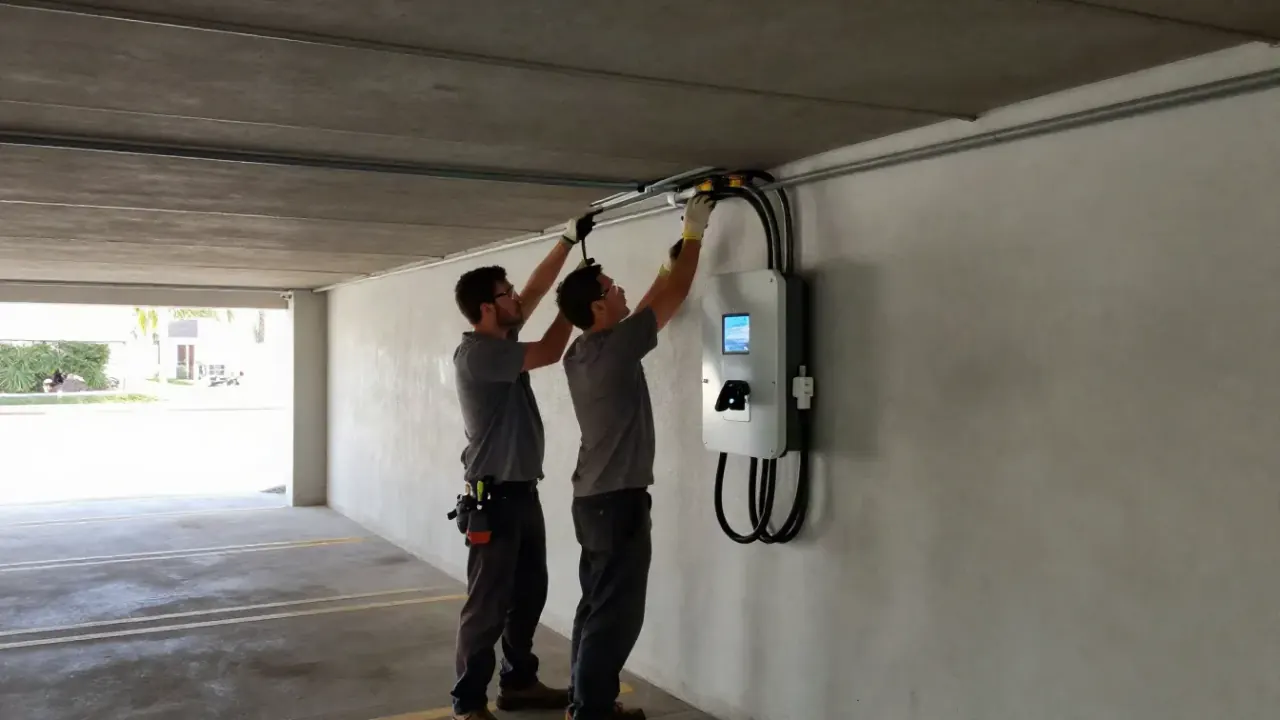
For most Redondo Beach garages, Level 2 is the right choice: it adds 25 to 35 miles of range per hour, so a full overnight charge takes 6 to 10 hours instead of the 40 to 60 hours a Level 1 cord needs. Level 1 stays workable only if you drive under 30 miles a day, park for 10-plus hours, and have a 120V outlet within cord reach.
Level 1 vs Level 2 EV charging is really a question about your daily miles, your panel, and how long your car sits still. We install both setups across the South Bay, and the answer changes block by block. Here is how to figure out which one your garage actually needs.
The Short Answer: Level 1 vs Level 2 EV Charging
Level 1 vs Level 2 EV charging is the comparison between a standard 120-volt household outlet and a dedicated 240-volt circuit that delivers roughly six to eight times the power to your car. Level 1 uses the outlet already in your garage. Level 2 requires an electrician, a breaker, and usually a permit.
Here is the honest breakdown:
- Level 1 (120V, 12-16 amps): 1.3 to 1.9 kW, adding 3 to 5 miles of range per hour. No installation. Comes free with the car.
- Level 2 (240V, 32-48 amps): 7.7 to 11.5 kW, adding 25 to 35 miles of range per hour. Needs a dedicated circuit, a hardwired unit or a NEMA 14-50 outlet, and a permit in most cases.
If you drive 40 miles a day and get home at 6 p.m., Level 1 leaves you scrambling by Thursday. Level 2 has you back to full before the 11 p.m. news ends. That gap is the whole decision.
How Long Does Level 1 Charging Take vs Level 2 in Redondo Beach CA?
How long Level 1 charging takes versus Level 2 in Redondo Beach CA depends on your battery size, not on the city - a 75 kWh pack takes roughly 50 hours on Level 1 and about 8 hours on a 40-amp Level 2 circuit. Here are real numbers for the three most common EV battery sizes we see in local driveways:
- 40 kWh (Nissan Leaf, older Bolt): Level 1 = 26-30 hours. Level 2 at 32A = 5-6 hours.
- 75 kWh (Model 3 RWD, Ioniq 5): Level 1 = 48-55 hours. Level 2 at 40A = 7-8 hours.
- 100 kWh (Model Y LR, Mach-E ER): Level 1 = 65-75 hours. Level 2 at 48A = 9-10 hours.
Those Level 1 numbers assume a clean 15-amp circuit with nothing else running on it. In a 1950s North Redondo garage where the same breaker feeds the laundry and the patio lights, you will trip the breaker or the car will derate itself to 8 amps - which stretches a 75 kWh pack toward 80 hours. We see that constantly on older properties, and it is one of the reasons so many homeowners around North Redondo EV Charger Installation end up moving to 240V within the first month.
Level 2 times also assume the circuit is sized correctly. A 40-amp breaker on a 50-amp circuit gives you 32 amps continuous - the 80% rule from NEC 625.42. Push a 48-amp charger on a 40-amp circuit and you will nuisance-trip all summer.
What Level 1 Actually Costs You
Level 1 looks free because the cord comes with the car, but the real cost shows up on your SCE bill and in your schedule. A 75 kWh EV driven 12,000 miles a year uses about 3,000 kWh. At Redondo Beach's 2026 residential rates - roughly 31 to 44 cents per kWh depending on your tier - that is $930 to $1,320 a year either way, because the energy is the same.
The difference is convenience and risk:
- You cannot precondition the cabin on a cold January morning without draining range.
- You cannot take advantage of SCE's TOU-D-PRIME off-peak window (9 p.m. to 4 p.m.) as effectively, because Level 1 needs the whole night plus part of the day.
- You risk overloading a shared 15-amp circuit, which is a fire hazard, not just an inconvenience.
We have pulled melted 14-gauge extension cords out of garages in the Avenues more than once. Nobody plans to run an EV off an extension cord for two years, but it happens.
What a Level 2 Setup Requires in a Redondo Beach Garage
A Level 2 setup in a Redondo Beach garage needs four things: a 240V circuit sized for the charger, a breaker with the correct amperage, a panel with enough spare capacity, and a permit from the City of Redondo Beach Building Division. Miss any one and the job stalls.
Typical 2026 pricing for a straightforward install in this area runs $850 to $1,800 for a NEMA 14-50 outlet on a short run, and $1,200 to $2,600 for a hardwired 48-amp charger. Add $400 to $900 if your panel needs a subpanel, and $1,500 to $4,000 if the service itself has to be upgraded from 100A to 200A.
What we check on every job:
- Panel capacity. A 100-amp panel with a 30-amp dryer, 40-amp range, and central AC is usually maxed. We run a load calculation before we quote anything.
- Wire run. Detached garages, garages on the far side of the house, and slab-on-grade builds in South Redondo can turn a 20-foot run into an 80-foot run through conduit.
- Charger choice. Hardwired units get you 48 amps; a NEMA 14-50 outlet caps you at 40 amps. If you want the fastest charge, hardwire.
- Permit and rebate paperwork. The city requires an electrical permit, and SCE's EV charger rebate program has its own forms.
If your panel is already full, we handle the fix in-house - Panel Capacity and Load Assessment Redondo Beach CA is the first step on almost every older home we touch, and it tells you in about 30 minutes whether you need a subpanel or a full service upgrade.
Is Level 2 Charging Worth It in Redondo Beach?
Is Level 2 charging worth it in Redondo Beach? Yes, if you drive more than 30 miles a day, own the home, and plan to keep the car past 2027. The math flips the other way for renters, low-mileage drivers, and anyone in a condo where the HOA controls the electrical room.
We tell homeowners to run three numbers before deciding:
- Daily miles. Under 30? Level 1 might hold. Over 40? Level 2 pays for itself in saved hours within a year.
- Years in the home. A $1,500 install spread over five years is $25 a month - less than one public DC fast-charge session per month.
- Future EVs. Every new EV sold in 2026 has a bigger battery than the one it replaced. A 40 kWh Leaf was fine on Level 1 in 2018. A 100 kWh crossover is not.
One more local factor: public charging near the beach is tight. The Riviera Village and pier garages fill up on weekends, and DC fast charging runs 45 to 65 cents per kWh. A home Level 2 charger at off-peak SCE rates is roughly half that. Homeowners we have worked with around Riviera Village EV Charger Installation usually cite that gap as the reason they stopped relying on public stations.
Which EV Charger Should I Install in My Redondo Beach Garage?
Which EV charger you should install in your Redondo Beach garage comes down to three picks: a NEMA 14-50 outlet, a hardwired 48-amp unit, or a Tesla Wall Connector. All three are 240V Level 2 solutions. They differ in speed, flexibility, and cost.
NEMA 14-50 outlet
The flexible option. You can unplug the charger and take it with you, or swap units later without an electrician. Caps at 40 amps continuous, which is 9.6 kW - about 30 miles of range per hour. Best for households that might move or lease the car. We install these constantly as NEMA 14-50 Outlet Installation Redondo Beach CA, and it is usually the lowest-cost path to Level 2.
Hardwired 48-amp charger
The fastest option short of a commercial unit. 11.5 kW, 35-plus miles of range per hour, no plug to wear out, and it can be set to a lower amperage if your panel is tight. This is what we recommend for anyone with a 100 kWh battery or a long commute.
Tesla Wall Connector
If you drive a Tesla, this is the cleanest install. It talks to the car, handles load sharing if you add a second unit later, and works with the J1772 adapter for non-Tesla EVs. We handle these as Tesla Wall Connector Installation Redondo Beach CA, including the commissioning step most DIY installs skip.
Whichever you pick, the circuit behind it matters more than the box on the wall. A 60-amp breaker on 6-gauge copper is the standard for a 48-amp charger. Anything thinner and you are asking for a hot conductor.
Common Mistakes We See on Home EV Charging Jobs
The mistakes we see most often on home EV charging jobs in Redondo Beach are undersized wire, missing permits, and chargers mounted where the cord cannot reach the port. Each one costs more to fix than to do right the first time.
- Running 8-gauge wire for a 48-amp charger. Code requires 6-gauge copper for a 60-amp circuit. The inspector will catch it, and so will your nose.
- Skipping the permit. Unpermitted electrical work surfaces at resale, and Redondo Beach buyers ask. It also voids some homeowner policies if a fire traces back to the circuit.
- Mounting the charger on the wrong wall. Measure from the car's charge port, not the garage door. A 25-foot cord does not reach as far as people think once it has to loop around a bike rack.
- Ignoring the 80% rule. A 50-amp circuit supports 40 amps continuous, not 50. Setting the charger to 48 amps on a 50-amp breaker trips it every time.
- Using a 12-gauge extension cord on Level 1. We have seen this melt outlets. If the cord does not reach, move the car, not the cord.
One more: buying a charger before checking the panel. We have watched homeowners spend $700 on a 48-amp unit, then learn their 100-amp service cannot feed it without a $2,500 upgrade. Get the load calculation first.
When to Call a Professional
Call a licensed electrician when your install involves anything past plugging a Level 1 cord into an existing outlet - new circuits, panel work, permits, and hardwired chargers all require it. In California, 240V EV circuit work falls under licensed electrical contracting, and Redondo Beach requires a permit for it.
We handle the whole job: load calculation, permit, wiring, charger mounting, and commissioning. If your panel is tight, we can add a subpanel instead of a full service upgrade, which saves most homeowners $1,500 or more. If you are in a condo or HOA building, we deal with the board and the shared-meter paperwork directly.
Redondo Beach EV Charger Installation is a local crew - we are in and out of garages from The Avenues to Golden Hills every week, and we know which panels in which neighborhoods tend to be full. If you want a straight answer on whether your garage can handle Level 2, we will tell you after a look, not after a sales pitch.
Frequently Asked Questions
Is Level 2 charging better than Level 1 in Redondo Beach?
Yes, for most homeowners. Level 2 adds 25 to 35 miles of range per hour versus 3 to 5 on Level 1, so a full charge takes 6 to 10 hours instead of 40 to 60. If you drive under 30 miles a day and park overnight, Level 1 can still work.
How long does Level 1 charging take vs Level 2 in Redondo Beach CA?
A 75 kWh EV takes about 50 hours on Level 1 and 7 to 8 hours on a 40-amp Level 2 circuit. A 100 kWh pack takes 65 to 75 hours on Level 1 and 9 to 10 hours on Level 2. Older shared circuits stretch those Level 1 times further.
Which EV charger should I install in my Redondo Beach garage?
A hardwired 48-amp Level 2 charger if you want the fastest charge and plan to stay put. A NEMA 14-50 outlet if you want flexibility or may move. A Tesla Wall Connector if you drive a Tesla. All three need a 240V circuit and a permit.
Do I need a permit for a Level 2 charger in Redondo Beach?
Yes. The City of Redondo Beach Building Division requires an electrical permit for new 240V circuits and hardwired EV chargers. The permit typically runs $150 to $400 depending on scope, and we pull it for you as part of the install.
Can I install a Level 2 charger myself in California?
Homeowners can pull an owner-builder permit for their own residence in some cases, but the work must meet NEC 625 and pass inspection. Most DIY installs we inspect fail on wire gauge, breaker sizing, or missing GFCI protection. The risk is fire, not just a failed inspection.
Get Help With EV Charger Installation in Redondo Beach
If you want a straight answer on whether your garage needs Level 1 or Level 2, we will run the load calculation, check your panel, and quote the job before we touch a wire. Most installs are done in a single day.
Call Redondo Beach EV Charger Installation at (310) 294-5464 to schedule your assessment.