Local GuidesEV Charging
EV Charger Installation for Condos and Townhomes in California
Yes, you can install an EV charger in a California condo or townhome. Here is how HOA approval, panel capacity, permits, and 2026 costs actually work in Redondo Beach.
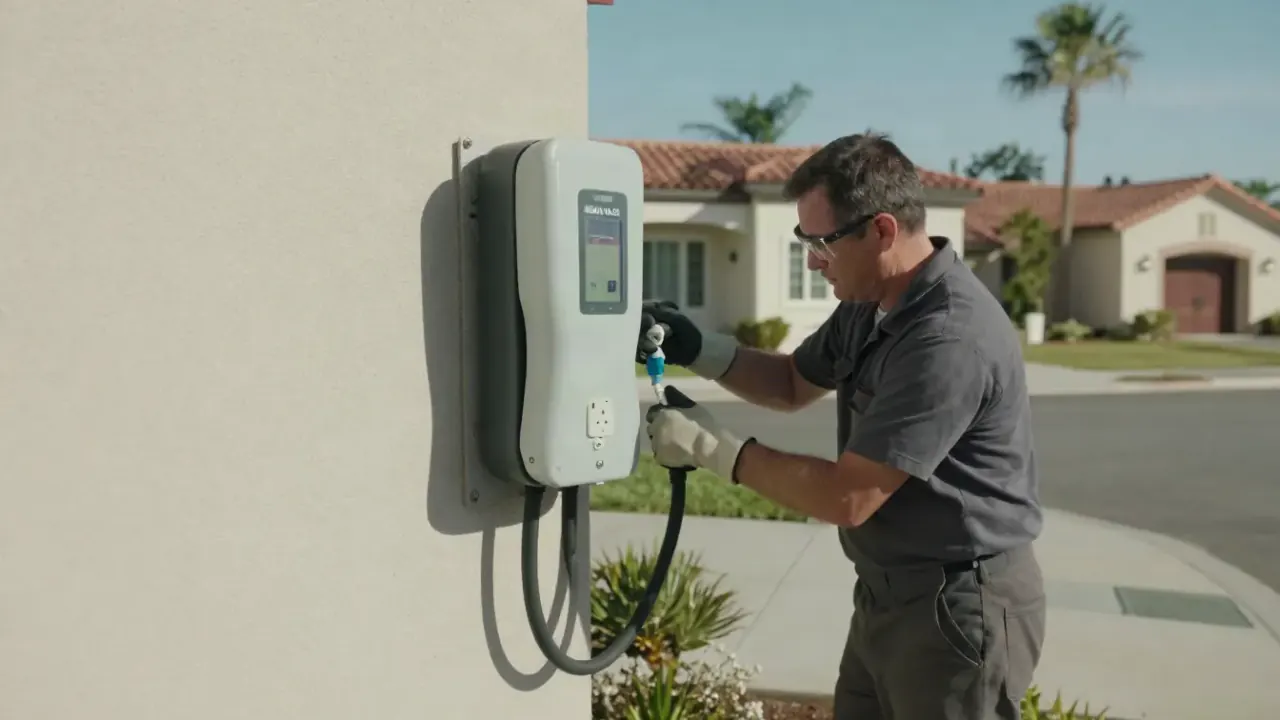
You can install an EV charger in a California condo or townhome, and in most cases you do not need the association's permission to charge your own car - you need it for how and where the wiring runs. California Civil Code Section 4745 gives owners in a common interest development the right to install an EV charging station on their own parking space, provided the installation follows the association's reasonable architectural standards and the owner covers the cost.
What that looks like in practice varies block by block in Redondo Beach. A ground-floor townhome in Villas South with a private garage is a two-hour job. A third-floor condo in North Redondo with a shared subterranean garage and a meter room 90 feet away is a different project entirely. The rest of this post walks through HOA approval, panel capacity, permits, and what installation actually costs in 2026.
Can you install an EV charger in a California condo or townhome?
Yes. EV charger installation for condos and townhomes in California is a protected owner right under Civil Code 4745, which applies to any common interest development - condominiums, townhomes, planned unit developments, and stock cooperatives. The statute was written specifically to stop HOAs from banning EV charging outright, and it has been amended twice since 2018 to close loopholes.
The law does not give you a blank check. Your association can require that the charger be installed by a licensed electrician, that you carry liability coverage naming the HOA, that you pay for the electricity you use, and that you remove the equipment and restore the space if you sell. Those conditions are standard and reasonable. What an HOA cannot do is demand you use their contractor, charge an application fee that exceeds actual review costs, or deny a request simply because the board is uncomfortable with EV technology.
If you own a townhome with an attached garage, you are in the easiest category. The charger goes on your own panel, on your own side of the meter, and the HOA's role is mostly limited to approving the conduit route if it crosses common area. If you own a condo with a deeded parking space in a shared garage, the conversation gets longer - but it is still a conversation you are entitled to have.
Why condos and townhomes are harder than single-family homes
The electrical work is not the hard part. The hard part is that in a multi-unit building, the wire has to travel through space that belongs to everyone.
On a single-family house in Golden Hills, we run conduit from the panel through the garage wall and mount the charger. Twenty feet of conduit, one 240V circuit, done. In a condo building, that same 20 feet might cross a common hallway ceiling, pass through a fire-rated demising wall, and terminate in a parking structure with its own structural rules. Every one of those transitions has an owner, and the owner is the HOA.
Three things drive the complexity:
- Distance from the panel. Shared meter rooms are often on the opposite end of the building from the parking spaces. Runs of 80 to 150 feet are common in Redondo Beach's larger condo complexes, and voltage drop becomes a real design constraint past 100 feet on a 40-amp circuit.
- Panel ownership. In a townhome, the panel inside your garage is yours. In a condo, the panel feeding your unit may be in a locked common-area electrical room, and the parking space may be on a completely different meter.
- Fire separation. Penetrations through rated assemblies need firestopping that passes inspection. This is not optional in a multi-unit building, and it is one of the most common reasons a DIY or handyman install fails inspection.
We handle these layouts constantly across EV Charger Installation in North Redondo CA, where the 1970s and 1980s condo stock has shared garages and panels that were never sized with EV loads in mind.
How to get HOA approval for an EV charger in Redondo Beach
HOA approval for EV charger installation in Redondo Beach moves fastest when you submit a complete package the first time. Boards are volunteer-run, they meet monthly at best, and an incomplete application gets tabled for 30 days. That is the single biggest source of delay we see.
Here is the package that gets approved on the first read:
- A written request identifying your unit, your parking space number, and the specific equipment you intend to install.
- A one-page scope from a licensed electrician describing the circuit size, the conduit route, and where the charger will be mounted.
- Proof of insurance - a general liability policy of at least $1 million naming the HOA as an additional insured, which is what most associations require.
- A signed acknowledgment that you will pay for the electricity, maintain the equipment, and remove it at your cost if you sell or the charger is abandoned.
- The city permit application, or a statement that you will pull the permit before work begins.
Submit it and ask to be placed on the next agenda. California law requires the association to respond within 60 days, and if they do not, the request is deemed approved. We have never needed to invoke that provision, but it exists for a reason.
One practical note: if your building already has a shared charging solution or a commercial operator under contract, the board may push you toward it. You are not required to use it. Your right to install on your own space stands. That said, if you are the board member reading this and you want to solve it for the whole building at once, our Condo and HOA Charger Installation Redondo Beach CA service covers shared and multi-unit systems, including load-sharing setups that let six cars charge off one service.
Panel capacity, subpanels, and shared meter rooms
Panel capacity is the technical question that decides your project's cost. A Level 2 charger draws 32 to 48 amps continuously, which is a serious load on a panel that may already be carrying an electric range, a dryer, and a 3-ton air conditioner.
We start every condo and townhome job with a Panel Capacity and Load Assessment Redondo Beach CA - a proper load calculation under NEC Article 220, not a guess based on breaker count. On a 100-amp service with gas appliances, there is often room for a 40-amp EV circuit. On a 100-amp service with electric everything, there usually is not.
When the main panel cannot take the load, you have four options, roughly in order of cost:
- Load management device. A current-sensing module that pauses the charger when the house approaches its limit. Adds roughly $400 to $900 to the job and avoids a service upgrade entirely.
- Subpanel. A new 100-amp panel fed from the main service, giving the EV circuit its own dedicated space. Our Subpanel Installation for EV Chargers Redondo Beach CA work typically runs $1,200 to $2,800 depending on run length and whether the meter room needs modification.
- Panel upgrade to 200 amps. $2,500 to $5,500 in this market, and it requires coordination with the utility for a meter disconnect.
- New dedicated service from the meter. Rare, expensive, and usually only justified when the parking structure is far from the building.
For most Redondo Beach townhomes with an attached garage, the answer is simpler: a Dedicated 240V Circuit Installation Redondo Beach CA from the existing panel, sized at 40 or 50 amps, feeding either a hardwired charger or a NEMA 14-50 receptacle. That covers the vast majority of daily charging needs - a 40-amp circuit adds roughly 25 to 30 miles of range per hour on a typical EV.
How much does condo EV charger installation cost in Redondo Beach?
Typical 2026 pricing for condo and townhome EV charger installation in Redondo Beach runs $1,400 to $4,500 for the electrical work, plus $400 to $700 for the charger itself if you supply your own. The spread is almost entirely about distance from the panel and whether the panel needs help.
Here is how the numbers break down in our experience:
- Townhome with attached garage, panel in the garage, 15-foot run: $1,400 to $2,000. This is the clean case, and it is a half-day job.
- Townhome with panel inside the unit, charger in a detached shared garage, 60-foot run: $2,200 to $3,200, including conduit, firestopping, and a permit.
- Condo with parking in a subterranean garage, 100-plus-foot run from a common meter room: $3,000 to $4,500. Add $400 to $900 if a load management device is required.
- Panel upgrade or new subpanel: add $1,200 to $5,500 depending on scope.
Permits in Redondo Beach for a residential EV circuit generally run $200 to $450 depending on valuation. If you want the charger to report usage and schedule off-peak charging, a Smart WiFi Charger Setup Redondo Beach CA adds $150 to $300 and is worth it in a shared-meter situation where you need to track exactly what you consumed.
We quote the whole job up front - parts, labor, permit, and inspection - so the number you hear is the number you pay.
Permits, inspections, and utility rebates
Every EV charger circuit in California requires a permit and a passing inspection. There is no legal shortcut, and an unpermitted circuit becomes a disclosure problem when you sell the condo.
The process in Redondo Beach is straightforward: we pull the permit, the city reviews the plan, we install, and the inspector signs off. Turnaround is usually two to four weeks from application to final inspection, with the inspection itself scheduled within a few days of the rough-in and final.
Rebates are worth chasing. Southern California Edison has offered residential EV charger rebates in the $500 to $1,000 range for qualifying customers, and the federal 30C tax credit covers 30 percent of installation costs up to $1,000 for projects in eligible census tracts - which includes most of Redondo Beach. Rebate programs change annually, so we verify current eligibility before we file. Our Permit and Utility Rebate Help Redondo Beach CA service handles the paperwork on both ends so you are not chasing documentation after the fact.
Common mistakes we see on condo and townhome installs
The mistakes that cost condo owners the most money are almost never electrical. They are procedural.
- Installing before HOA approval. Even though Civil Code 4745 protects your right to charge, installing without following the association's architectural process gives the board grounds to require removal at your expense. Get the approval in writing first.
- Assuming the panel is fine because the lights do not flicker. A load calculation is the only way to know. We have seen 100-amp panels in 1980s Redondo Beach townhomes that were already at 85 amps of calculated load before the EV was added.
- Running undersized wire for a long garage run. A 100-foot run on 8-gauge copper will not hold a 48-amp charger within acceptable voltage drop. The wire has to be upsized, and that changes the material cost.
- Skipping firestopping. Any penetration through a rated wall or ceiling in a multi-unit building needs an approved firestop system. Inspectors look for it, and so do insurance carriers after a loss.
- Buying a 48-amp hardwired charger for a 40-amp circuit. Match the charger to the circuit, or you will be running it at a derated setting forever.
If you already have a charger that is tripping breakers or charging slower than it used to, the issue is usually the circuit rather than the unit. Our EV Charger Repair and Troubleshooting Redondo Beach CA team diagnoses those in a single visit.
When to call a professional
Call a licensed electrician the moment your project involves a shared meter room, a common-area conduit run, a fire-rated wall, or a panel that might be near capacity. Those four conditions cover most condo and townhome installs in Redondo Beach, and each one has a code requirement that a general handyman will not meet.
Redondo Beach EV Charger Installation handles the whole sequence - load calculation, HOA paperwork, permit, installation, and inspection - so you are not coordinating three different trades and a board meeting. We work in the beach cities every week and we know what the local inspectors and the larger associations expect to see.
Frequently Asked Questions
Can I install an EV charger in my condo in Redondo Beach?
Yes. California Civil Code 4745 gives condo owners the right to install an EV charger on their own parking space, as long as you follow the HOA's reasonable standards, use a licensed electrician, and carry liability insurance. Your association cannot ban it outright. Most Redondo Beach condo installs run $1,400 to $4,500 depending on distance from the panel.
Do I need HOA approval for an EV charger in Redondo Beach CA?
You need HOA approval for the installation method, not for the right to charge. Submit a written request with a licensed electrician's scope, proof of $1 million liability insurance naming the HOA, and a permit application. California law requires the board to respond within 60 days, and no response counts as approval.
How much does condo EV charger installation cost in Redondo Beach?
In 2026, expect $1,400 to $2,000 for a townhome with a garage panel and a short run, $2,200 to $3,200 for a 60-foot run through common area, and $3,000 to $4,500 for a subterranean garage with a 100-foot-plus run. Panel upgrades or subpanels add $1,200 to $5,500.
How long does the installation take?
The electrical work is usually one day for a straightforward townhome and one to two days for a condo with a long conduit run. Add two to four weeks for permit review and inspection scheduling with the City of Redondo Beach. HOA review adds another 30 to 60 days if your board meets monthly.
What if my building's panel does not have capacity?
You have options short of a full service upgrade. A load management device costs $400 to $900 and lets the charger share capacity with existing appliances. A dedicated subpanel runs $1,200 to $2,800. A full 200-amp panel upgrade is $2,500 to $5,500 and is only necessary when the calculated load genuinely exceeds the service.
Get help with EV Charger Installation in Redondo Beach
Whether you are in a Villas South townhome with a garage panel or a North Redondo condo with a 120-foot run to the meter room, we can tell you within one visit what your building will support and what it will cost. Call Redondo Beach EV Charger Installation at (310) 294-5464 to schedule your assessment.